
Barefoot Shoes vs. Running Shoes

"Your feet were built to move freely, not to sit locked inside thick padding. Barefoot shoes let your toes spread, your arch flex, and your stride adapt to the ground beneath you. Running shoes cushion every step but limit natural motion. The right choice depends on your goals, your gait, and your feet."
Barefoot shoes and running shoes solve the same problem in opposite ways. Running shoes add cushioning, structure, and support to protect your joints from repeated impact. Barefoot shoes remove all three and let your foot do the work on its own. Both styles have loyal fans, and both can carry you through a workout, a hike, or a full day on your feet. The choice between them shapes how your foot lands, how your muscles fire, and how your body absorbs each step.
The real difference sits in the sole. Running shoes raise your heel above your toes and stack foam underneath to soften impact on hard pavement. Barefoot shoes keep your foot flat and close to the ground, so your foot senses the surface directly instead of through a layer of foam. This changes how your foot lands, how your muscles fire, and how much ground feel you get with every step. Ground feel means direct sensory contact with the surface under you, and it shapes balance, posture, and reaction time on uneven terrain.
Wide Toe Box
TOES SPREAD AND GRIP
Thin Flexible Sole
FEEL THE GROUND CLOSELY
Zero-Drop Platform
HEEL AND TOE LEVEL
These three traits define a barefoot shoe. A wide toe box gives your toes room to spread and grip the ground on push-off. A thin, flexible sole bends with your foot instead of fighting it at every joint. A zero-drop platform keeps your heel and forefoot level, so your spine stays in a natural line from your feet to your hips. Running shoes take the opposite approach on all three counts, and that gap is where most buying decisions start.
Our Top Pick
Start Your Barefoot Journey
If you're ready to try barefoot walking or light trail use, start with a shoe built for both stability and flexibility.
★★★★★
HYKES Nomad — Zero-Drop Barefoot Shoes
WIDE TOE BOX · ZERO-DROP · TRAIL-READY
The HYKES Nomad is a flexible, foot-shaped hiking shoe with a wide toe box that lets your toes splay and grip naturally over uneven terrain. Its thin, zero-drop sole keeps your foot close to the ground for real trail feedback and a balanced, connected stride, whether you're covering rocky paths or logging easy miles.
- Wide toe box for natural toe spread
- Zero-drop sole for balanced alignment
- Thin, flexible sole for ground feel
- Foot-shaped design that moves with you
- Breathable material for all-day wear
- Goes anywhere — trail, work, or errands
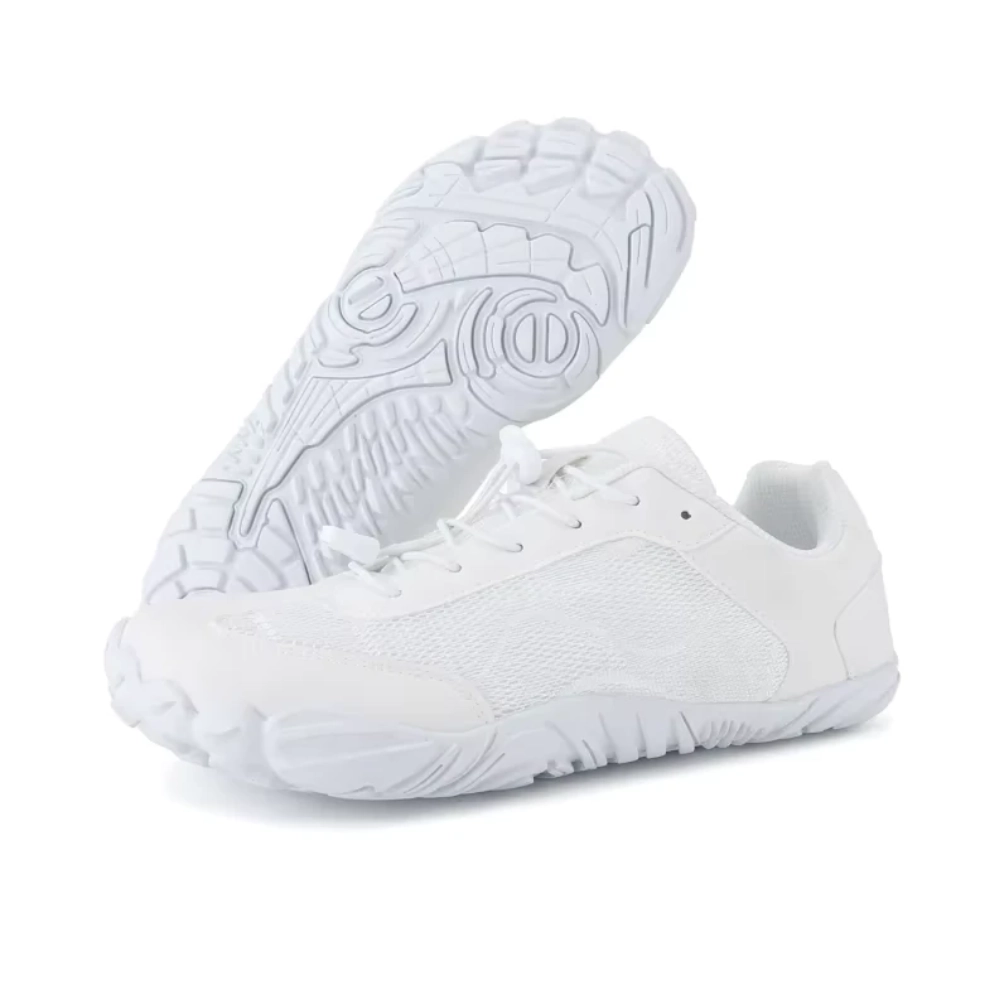
STRIPPED-DOWN SHOE DESIGN
What Is a Barefoot Shoe?
A barefoot shoe strips a running shoe down to its base function: protection. It has no raised heel, no thick midsole, and no rigid arch support built into the frame. The sole is thin enough to feel small changes in the surface below you, like a root on a trail or a seam in a sidewalk. The upper is wide enough to let your toes splay naturally when you push off the ground, instead of pinching them together at the front.
A running shoe builds up instead of stripping down. Engineers add foam to absorb shock on hard pavement over long, repetitive distances. They raise the heel to shorten your stride and reduce strain on the ankle and Achilles tendon. They narrow the toe box for a snug, locked-in fit during fast turnover at speed. Both designs are intentional choices made for different outcomes, not one right answer and one wrong one.
Wider Toe Splay
Toes spread and grip better.
True Ground Feel
You sense the terrain directly.
Level Posture
Zero-drop keeps hips aligned.
Stronger Foot Muscles
Your arch works instead of resting.
Lighter Every Step
Less foam means less fatigue.
One Shoe, Many Terrains
Handles trail, gym, and street runs.
"I switched to barefoot shoes for hiking and noticed my balance on rocky trails within two weeks. My feet feel stronger, not just different."
— Rachel M.
BAREFOOT SHOES OVER TIME
A Short History of Barefoot Shoes
Humans ran and walked barefoot for most of history. Shoes existed mainly for protection from sharp ground and cold weather, not for cushioning or support. Early footwear stayed thin and flexible because materials were limited and feet needed to work as they evolved, carrying full body weight across rough terrain without a built-up sole to lean on.
The modern running shoe changed that pattern in the 1970s. Brands added foam midsoles and raised heels to reduce impact on newly common paved roads. Sales grew fast, and cushioned shoes became the default choice for runners and walkers alike for decades. Barefoot and minimalist shoes returned to the market in the 2000s, driven by research on natural gait patterns and growing interest in reducing dependence on built-up soles. Today both styles sell side by side, and shoppers pick based on activity, comfort, and long-term foot health goals rather than one dominant trend.
Our Top Pick
Ready to Feel the Ground?
A zero-drop, wide-toe design gives you the barefoot benefits without giving up trail protection.
★★★★★
HYKES Nomad — Zero-Drop Barefoot Shoes
WIDE TOE BOX · ZERO-DROP · TRAIL-READY
The HYKES Nomad is a flexible, foot-shaped hiking shoe with a wide toe box that lets your toes splay and grip naturally over uneven terrain. Its thin, zero-drop sole keeps your foot close to the ground for real trail feedback and a balanced, connected stride, whether you're covering rocky paths or logging easy miles.
- Wide toe box for natural toe spread
- Zero-drop sole for balanced alignment
- Thin, flexible sole for ground feel
- Foot-shaped design that moves with you
- Breathable material for all-day wear
- Goes anywhere — trail, work, or errands
SPECS, SIDE BY SIDE
Barefoot Shoes vs. Running Shoes: Key Differences
Specs tell the clearest story. Compare the two styles across the traits that matter most for fit, feel, and long-term use.
|
Feature |
Barefoot Shoes |
Running Shoes |
|---|---|---|
|
Heel-to-Toe Drop |
0mm |
8–12mm |
|
Sole Thickness |
Thin (3–6mm) |
Thick (20–35mm) |
|
Toe Box Shape |
Wide, foot-shaped |
Narrow, tapered |
|
Weight |
Light (150–250g) |
Heavier (250–350g) |
|
Cushioning |
Minimal |
High |
|
Break-In Period |
Weeks to months |
Days |
|
Best For |
Gait strength, ground feel |
Long-distance road impact |
Running shoes reduce impact stress on hard surfaces and support a heel-first landing pattern common in road running. Barefoot shoes push impact absorption back onto your own muscles and tendons, which strengthens them over time but demands a slower, more patient start. Neither row in that table makes one shoe universally better than the other. The right fit depends on your surface, your typical distance, and your current foot strength going in.
EASING INTO BAREFOOT SHOES
Transitioning to Barefoot Shoes
Moving from a cushioned running shoe to a barefoot shoe takes time and a deliberate plan. Your foot muscles need to rebuild strength that built-up soles replaced for years, sometimes decades. Rush the switch and you risk soreness in your calves, arches, and Achilles tendon, or worse, a stress injury that sets your progress back.
- Wear barefoot shoes for short walks first, 20 to 30 minutes at a time.
- Add one short session per week instead of switching all at once.
- Practice on smooth, flat ground before moving to trails or uneven surfaces.
- Watch for calf and arch soreness, and rest fully when it appears.
- Reach full-time wear only after your feet adapt, often 4 to 8 weeks.
- Track how your feet feel each week and adjust your pace accordingly.
KEEPING THE SOLE READY
Caring for Barefoot Shoes
Barefoot shoes use thinner materials than running shoes, so proper care extends their life and keeps the sole performing the way it should.
- Rinse mud and dirt off the sole after every trail use.
- Air-dry shoes away from direct heat to protect the sole material.
- Rotate between two pairs if you wear barefoot shoes daily.
- Check the sole for wear points every few weeks, especially at the forefoot.
- Store shoes flat, not folded, to keep their natural shape.
- Replace the sole once tread depth wears down noticeably, usually after heavy trail use.
Our Top Pick
Make the Switch Today
Give your feet room to work the way they're built to, on trail or on pavement.
★★★★★
HYKES Nomad — Zero-Drop Barefoot Shoes
WIDE TOE BOX · ZERO-DROP · TRAIL-READY
The HYKES Nomad is a flexible, foot-shaped hiking shoe with a wide toe box that lets your toes splay and grip naturally over uneven terrain. Its thin, zero-drop sole keeps your foot close to the ground for real trail feedback and a balanced, connected stride, whether you're covering rocky paths or logging easy miles.
- Wide toe box for natural toe spread
- Zero-drop sole for balanced alignment
- Thin, flexible sole for ground feel
- Foot-shaped design that moves with you
- Breathable material for all-day wear
- Goes anywhere — trail, work, or errands
FAQ
Yes, for short distances and slow buildup. Runners who switch gradually often report stronger calves and better form, but sudden switches raise injury risk, so a slow transition period matters more here than with any other change in gear.
Most models include a thin protective layer, usually 3 to 6mm, to guard against sharp objects on the trail without blocking ground feel or changing how your foot lands.
Most people need 4 to 8 weeks of gradual wear before switching full time. Foot strength and comfort build gradually with regular short sessions rather than one long trial.
Yes. A wide toe box and flat sole reduce pressure points during long standing shifts, though regular breaks and movement still help circulation and comfort over an eight-hour day.
Neither style is universally better. Barefoot shoes build foot strength and support natural movement patterns. Running shoes protect against high-impact stress on hard surfaces over long distances.
Look for a wide toe box, a zero-drop sole, and a thin, flexible base. Fit and flexibility matter more than brand name or price point when you're starting out.
Final Verdict
Barefoot shoes and running shoes serve different goals, and that difference matters more than any single spec on its own. Running shoes protect your joints on long, hard-surface distances with cushioning and structure built up over decades of design. Barefoot shoes rebuild natural foot strength and give you direct ground feel, at the cost of the built-in shock absorption you get from foam.
Choose based on your activity, your current foot strength, and how much support you want between your foot and the ground. Many people keep both styles in rotation, using each one for the situations it handles best, rather than picking a single winner for every mile they walk or run.
Strong feet start with room to move, and the right shoe gives them that room, step by step. 🦶